Animais de Produção e Saúde Pública
Milk Quality
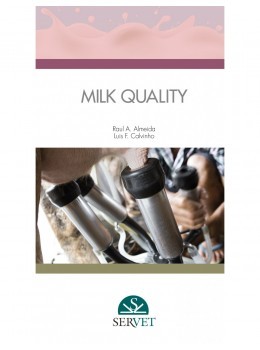
De: Raul A. Almeida y Luis F. Calvinho
ISBN: 9788417640361
2019, Servet
Capa dura
Páginas: 100
Animais de Produção e Saúde Pública
De: Raul A. Almeida y Luis F. Calvinho
ISBN: 9788417640361
2019, Servet
Capa dura
Páginas: 100
Every dairy operation should produce máximum quantities of high quality milk. Since mastitis is the main threat to milk quality and therefore, dairy farm profits, it is essential to identify the etiological agents to implementing intramammary infection treatment and/or establishing control programs. This handbook, which highlights the importance of achieving high quality milk levels through a practial and visual approach, has been written by authors with a wide experience in this field. Numerous graphic resources have been included to complement the information provided and make the contents more understandable and accessible to readers.
1. Essential equipment and materials for mastitis diagnostic work
2. Milk samples collection and handling for diagnosis of bovine intramammary infections and bulk tank analysis
3. General cultural procedures
Culture media
Inoculation
Incubation
4. Identification of frequently isolated bacteria isolated from bovine milk (basic and additional tests)
Staphylococci
Streptococci
Coliform bacteria
Coryneforms
5. Identification of less frequently isolated bacteria isolated from bovine milk (basic tests)
Mycoplasmas
Prototheca sp.
Yeasts
Bacillus sp.
Trueperella pyogenes
Nocardia sp.
6. Molecular methods for identification and typing of pathogens of the bovine mammary gland
PCR, multiplex-PCR, RT-PCR
MALDI-TOF
PFGE
MLST
Next generation sequencing
7. Antibiotic susceptibility tests Disk method
Dilution methods
Interpretive criteria
8. Bulk tank analysis
Cultures procedures
Coliform count
Standard plate count
Laboratory pasteurization count
Preliminary incubation count
Streptococci count
Staphylococci count
Staphylococcus aureus
Streptococcus agalactiae
Interpretation of results
|
Raul A. Almeida Dr. Raul A. Almeida obtained his degree in Veterinary Medicine (DVM) from the University of Littoral (Argentina) in 1975. After his graduation, Dr. Almeida worked at the Rafaela Experimental Station of the National Institute of Agriculture Technology (INTA-Argentina) as head of the microbiology diagnostic laboratory of the Animal Health Unit. In 1985, he moved to Iowa State University to pursue his postgraduate programs, obtaining his MSc (1988) and PhD (1991) in Veterinary Microbiology. In 1991, he moved to The University of Tennessee (Knoxville) joining to Dr. Steve Oliver’s mastitis research group where he concentrated his career on the pathogenesis of bovine mastitis. During his tenure at this research group, he published over 90 peer-reviewed papers, over 150 proceedings, several divulgation articles and book chapters. He has participated as invited speaker at meetings and congresses in Europe, South East Asia, Oceania, Central and South America. His research interests have been focused on the pathogenic strategies and identification of virulence factors aiming to the developing of vaccines to control mastitis environmental pathogens, particularly Streptococcus uberis. In 2010, he became director of The University of Tennessee Mastitis Quality Milk Laboratory, focusing on milk microbiology as well as on developing mastitis control programs aiming to improving the profitability of dairy farms. In this latter, he has been involved in training courses on prevention and control of bovine mastitis directed to milkers and dairy farmers. |
|
Luis F. Calvinho Luis F. Calvinho is a veterinarian specialized in research, extension and teaching in bovine mastitis and milk quality. He graduated in 1981 from the Faculty of Veterinary Science of University of Buenos Aires (Argentina) and obtained a postgraduate Bacteriology diploma from University of La Plata (Argentina), Master of Veterinary Medicine (MVM) from University College Dublin (Ireland) and a PhD from The University of Tennessee (USA). He carried out research and bacteriological diagnosis of dairy cattle diseases at the Rafaela Experiment Station of the National Institute of Agricultural Technology (INTA-Argentina). Since 1997, he coordinates the Bovine Mastitis and Milk Quality Service at the Rafaela Experiment Station that provides laboratory assistance, field diagnosis and advising to veterinarians and farmers managing mastitis problem herds. He has been involved in teaching training courses on bovine mastitis to dairy industries personnel, farmers and veterinarians. He is currently Professor of Infectious Diseases at the University of Littoral and Catholic University of Córdoba (Argentina), teaching in undergraduate and postgraduate levels. His main research interests within the mastitis field are pathogenesis, prevention and epidemiology. He has directed or co-directed graduate students pursuing Doctoral (8) and Magister (8) degrees and published 85 peer-reviewed articles (34 Spanish and 51 English), divulgation articles (20) and book chapters (11). He has contributed as a reviewer for more than 25 journals worldwide. He has participated as invited speaker at seminars and meetings in South America and USA and currently serves as a member of the Board of Directors of the World Association of Veterinary Laboratory Diagnosticians (WAVLD). He conducted research studies and served as external advisor for veterinary pharmaceutical companies. He served as advisor of the Research Center of Veterinary and Agricultural Sciences (INTA) and currently coordinates an Institutional Project (INTA) involving parasitic, infectious and toxic-metabolic diseases that affect productivity of beef and dairy cattle |